Merchant account vs payment gateway vs payment aggregator: what's the difference?
Merchant account vs payment gateway vs payment aggregator explained: what each one does, who holds the money, and which a small cross-border seller needs.
On this page
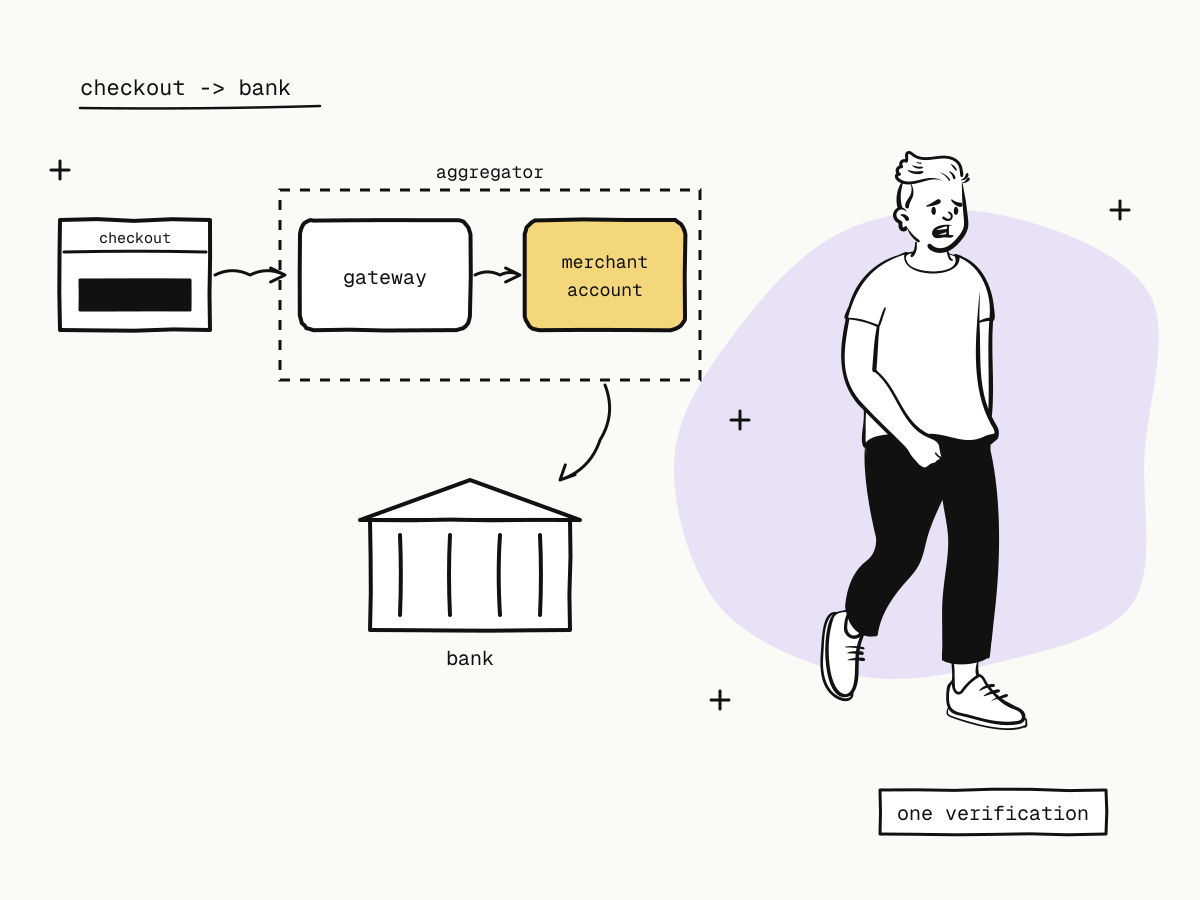
A merchant account and a payment gateway do different jobs. A payment gateway is the technology that carries a payment from your checkout to the networks and back with an answer; a merchant account is the account with an acquiring bank that receives the money from card payments before it reaches your bank. A payment aggregator puts both behind one sign-up: it holds the acquiring relationship itself and processes your payments under it, so you do not open a merchant account of your own.
This guide explains what each of the three does, how the money moves in each model, the trade-offs, and which one a small business selling across borders usually needs.
What is a payment gateway?
A payment gateway is the connection between where the buyer pays and the payment networks. It collects payment details securely (or hands that to a hosted page), sends the payment for authorisation, and returns the result to your system. It moves data, not money: on its own, a gateway does not hold or settle funds.
What you see of a gateway is its checkout, its API and its notifications — see what is a hosted payment page and payment gateway integration.
What is a merchant account?
A merchant account is an agreement with an acquiring bank (the acquirer) that lets a business accept card payments. The acquirer receives the funds from the card networks, holds them for a while, deducts its fees and settles the rest to the business's bank account. Getting one means an underwriting review of the business, and often a separate contract for each region or payment method.
What is a payment aggregator?
A payment aggregator (also called a payment facilitator) holds the merchant account itself and onboards many businesses under it. Each business is verified by the aggregator rather than by the acquirer directly, gets a balance with the aggregator, and is paid out from it. The gateway is usually part of the same service.
Merchant account vs payment gateway vs aggregator, compared
| Payment gateway | Merchant account | Payment aggregator | |
|---|---|---|---|
| What it does | Carries the payment and the result | Receives and settles card funds | Both, under one service |
| Who holds the money | Nobody — it moves data | The acquirer, for you | The aggregator, for you |
| Who verifies you | — | The acquirer | The aggregator |
| Getting started | Integration | Underwriting, often per region | One verification |
| Pricing | Per transaction or monthly | Negotiated, often several fees | Usually one per-payment price |
| Risk monitoring | — | Per merchant account | Per merchant, inside a shared account |
How the money moves
- Gateway plus your own merchant account: buyer → gateway → card network → your acquirer → your bank. You hold two contracts and reconcile two sets of statements.
- Aggregator: buyer → the aggregator's checkout → the networks → the aggregator's acquiring account → your balance with the aggregator → a payout to your bank.
The second model adds one step — the payout — and that step is where an aggregator's rules show: when funds become withdrawable, minimums, fees and reviews. See what is payment settlement.
Where KukoPay fits
KukoPay works as an aggregator with its own gateway:
- One verification, no merchant account to open. You apply once with your business documents — see what is KYB verification. The sandbox works before approval.
- A hosted checkout and an API for cards, Apple Pay, Google Pay, Alipay, WeChat Pay and PayPal, where enabled on your account.
- One price per payment. Standard pricing is 3.5% plus a fixed fee in the order's currency — see how cross-border payment fees are calculated.
- A balance per currency (USD, HKD, CNY), paid out to a settlement account that is reviewed before it can receive money.
- Shared-account rules. Because the acquiring account is shared, the platform watches each merchant's chargeback rate and suspends payouts at 0.9% (with at least 3 disputes in 30 days), and some businesses cannot be processed at all — see prohibited businesses.
Which one do you need?
- You process large volumes, want negotiated acquiring rates and can go through underwriting in each market → your own merchant account, with a gateway.
- You are starting out, selling across borders, or want to take payments this week → an aggregator. One verification and one contract replace an acquirer relationship per region.
- You already have a merchant account → you only need a gateway that connects to it.
Many businesses start with an aggregator and only consider their own merchant accounts once volume makes negotiated rates worth the extra contracts and reconciliation.
Summary
- A payment gateway carries the payment and its result; a merchant account is the acquiring relationship that receives and settles the money;
- a payment aggregator holds the merchant account itself and onboards you under it, usually with its own gateway;
- with an aggregator you skip opening a merchant account, in exchange for its rules on payouts, chargebacks and prohibited businesses;
- KukoPay is an aggregator with a hosted checkout and API: one verification, one per-payment price, a balance per currency and reviewed payouts;
- choose your own merchant account for large negotiated volume, an aggregator to start selling across borders quickly.
Try it in the sandbox
Create a merchant account and request a test key. The sandbox needs no business verification.